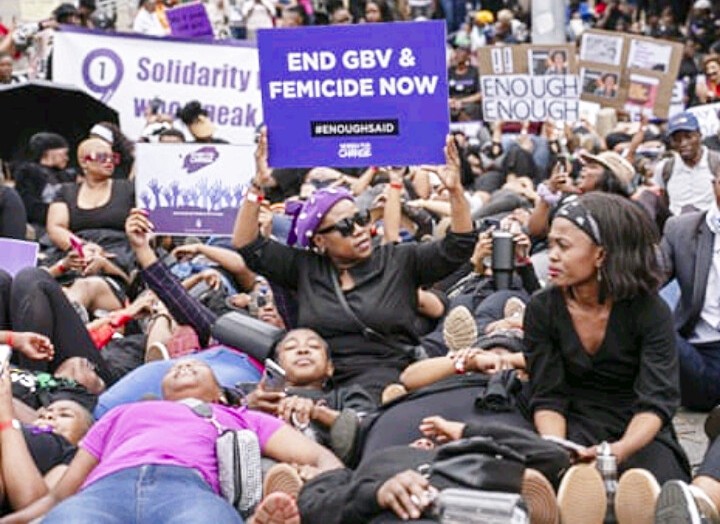
On 21 November 2025, hundreds — and in some cities thousands — of women across South Africa took part in a nationwide “shutdown” protest. From Johannesburg and Pretoria to Cape Town, Durban and beyond, women brought major cities to a standstill in a powerful stand against femicide.
Participants wore black to symbolize mourning and resistance, and at midday lay silently on the ground for 15 minutes — one minute for each of the approximately 15 women killed every day in South Africa.
The action was organised by Women for Change, an NGO that urged women to withdraw from all paid and unpaid work, schools and domestic duties to highlight the social and economic value of women’s presence in society.
Timed just ahead of the G20 Summit in Johannesburg, the protest aimed to leverage global attention and spotlight South Africa’s alarming rates of gender-based violence. According to UN Women, the country’s femicide rate is roughly five times the global average, making it one of the world’s most dangerous places for women.
Activists say the crisis is rooted in deep systemic issues — patriarchy, inequality, weak law enforcement, and social norms that enable or excuse violence.
Their chief demand: for gender-based violence and femicide (GBVF) to be declared a national disaster, ensuring urgent, coordinated and well-resourced action from government institutions.
Important Highlights Of The 2025 National Women’s Summit
Following intense public pressure and nationwide support — including a petition said to have gathered more than a million signatures — the National Disaster Management Centre (NDMC) officially declared GBVF a national disaster. The move is expected to improve coordination across law enforcement, justice, social services, and policy.
Often referred to as the “G20 Women’s Shutdown,” the protest marks a shift from isolated outrage to organized, large-scale pressure for structural change. It underscores a growing nationwide demand for accountability, safety, legal reforms, better protection systems, and recognition that violence against women is not a private issue but a national crisis.